
E.T. Hansen

American Writer in Europe
He grew up in the 70’s, a social outcast addicted to fantasy books and dreaming of the Middle Ages; editing the high school newspaper and contributing to it the anonymous satirical column “Our Man in the Bathroom;” yearning to go to Europe and become a writer in a black turtleneck sitting in a cafe on the Seine.
Raised a Mormon, and a believer, he got to Europe as a Mormon missionary, landing in Germany, falling in love with it and with a German girl.
This was the 80s now. Back home, he studied Linguistics and saved his money to return to Germany, marry the girl and study Mediävistik (the Literature of the Middle Ages) in Munich.
The plan was to teach and write great novels in the summer, but he was not a great student and after his Master’s (Magister) he to journalism, left the church, divorced and moved to Berlin – just after the fall of the Wall.
As a freelancer, he wrote for The European, The International Herald Tribute, The Washington Post (German culture), Variety, was Germany Bureau Chief for The Hollywood Reporter (media business).
He began writing in German for Süddeutsche Zeitung, Cicero, GEO, Die Zeit, Hamburger Morgenpost (German-American politics), RBB (Radio); he wrote a 2-year satirical political column “Wir Amis” for Die Zeit and won the George Kennen Award for Journalism in Trans-Atlantic Relations for an article in the NZZ (Switzerland).
In 2001, faced with mid-life and still not having fulfilled his dream of finding the Middle Ages, he quit everything, undertook a 1-year journey through Germany and Austria in search of the Middle Ages, and wrote his first book about it: “Die Nibelungreise.”
There followed a dozen non-fiction, often humorous books for major publishers about German-American culture, history and relations, often written . with co-writer Astrid Ule. These included “Planet Germany” and “Planet America,” and for the successful thriller trilogy “Neuntöter,” “Blutbuche” and “Wassertöchter” (under the name Ule Hansen), he (they) won the Crime Writer’s Prize of the Stuttgart Crime Festival.
Now:
– Side experiments in self-publishing (“Losing my Religion” and micro-publisher Hula Ink);
– teaching creative writing and coaching young authors for writing schools and privately;
– preparing a new series of English-language dark mysteries;
– living in Berlin with Astrid Ule.
So how was Hawaii?
Hawaii really is paradise and America’s only true melting pot. Everything is beautiful, the people too. But I was too skinny, my glasses too thick, too haole (white). I did not do well on the beach, on a surfboard or with the girls; not a week went by when the mokes did not beat or rob me. So I did what so many weaklings and social outcasts did before: I dreamed of escaping to Europe to become a writer. Only when I got here, did I realize what I gave up.
How to go to Hawaii
If you have to be broke, do it in style
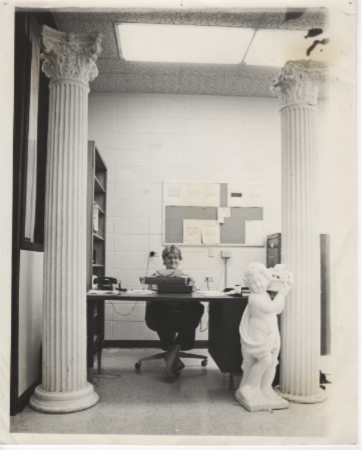
Dad was of an American man of a more robust generation – he served in World War II and in the Korean War and saw what real Nazis and Communists were; he did his duty without complaining and made the most of life sanding on his own two feet.
He ran a business in Bellingham grinding lenses. When it failed, his partner made off with the money and his relatives, who had invested, changed the locks of the business so he wouldn’t get any big ideas about selling off the remaining equipment and leaving himself.
I imagine that was the low point of his life.
So he said to himself, “I can be broke here in rainy, dark, cold Bellingham, or I can be broke someplace nice.”
He scraped together the rest of the money he had and sent our two big sisters off to Honolulu find an apartment for the rest of us.
Then, one early morning, in the dark, when I was 6, Mom packed my clothes into a tiny suitcase for me to carry and piled us into Grandpa’s car (we were all staying at my Grandparents’ house by then) and drove to the Seattle airport, got on a plane and stepped off on the sunny tarmac in Hawaii.
1966. Lanikai, Hawaii. But you never appreciate what you have when you have it. I spent my time in paradise reading books in a dark room and dreaming of the Middle Ages.
Hawaii really is paradise, and a true melting pot. It was normal for me – a haole – to be in the minority.
My dream was to go to Europe, see the Middle Ages, maybe discover a real dragon sleeping the sleep of ages under a castle ruin, and become a writer in a black turtle neck sweater in a cafe beside a river somewhere where spies are swapped at midnight
So how was High School?
Worst part: Getting beaten and robbed every week by mokes. Best part: Editing “The Surfrider,” our Kailua High School newspaper, and contributing to it an anonymous, satirical column sarcastically lampooning everything that is sacred, “Our Man in the Bathroom.” I never wanted to learn journalism, but my father said, “If you want to be a writer, you have to learn how to write,” and basically forced me into it. I not only learned how to write, I learned the power of publishing: You’re only a dumb, inexperienced kid with a dumb opinion, but if you write it with a little humor and in an interesting way, people will read it and talk about it and suddenly people who never knew you before want to talk to you.
How to go to Europe to become a writer
The dreams of a dumb kid growing up in Hawaii
It’s hard to imagine it now, but there was a time – back the old days – when writers were admired, and young people aspired to become one. Yes, boys and girls, back then people were crazy.
In 1990, I had my Master’s but knew I was not cut out for academia. So I turned to the craft my father had forced me to learn.
I bought up every English-language newspaper I could find and called the editorial offices and asked them if they needed a correspondent. I was sure I would have not luck – guys who get correspondent jobs are either well-connected, or they have worked their way up from the mail room. I was sure they would smell the dumb kid in me.
But they said, “Send me something.”
So I wrote up a story about some eccentric German artist who was tattooing bar codes on his skin (he was the first) and the now-defunct “The European” printed it.
I was shocked. These guys didn’t care about degrees or CVs, they needed something to fill their pages.
It’s a lesson tat seems obvious to me now, but it wasn’t then:
A writer is kind of one-man business. His first question isn’t what to write or how, it’s what the reader wants to read. If he can figure that out, he can get someone to publish the story.
When I turned 40, I had to make a decision: Either go to Los Angeles and become international editor for “The Hollywood Reporter” or finally realize my dream of finding the Middle Ages. So I threw it all away and took the trip I had always dreamed of taking.
But I wasn’t dumb. The writer in me knew there was a book in it ad he knew how to sell it, too.
Every little town I visited, following the footsteps of Hildegard von Bingen, Charlemagne, Faust, Walther von der Vogelweide and others, I called the local newspaper office and told them a crazy American was in town looking for clues to some local hero of theirs nearly a thousand years ago.
The next morning my picture appeared in the paper.
When I went looking for a publisher a year later, I had a folder full of news clippings about my journey under my arm.
They didn’t care about the articles themselves – they knew everything they needed to know just by looking at the size of the folder:
My trip through the Middle Ages was interesting for newspapers and their readers – I had a market.
I was a believing Mormon and I knew there was a good chance I would accept a calling to go on a two-year mission for the church. I also wanted to get to Europe. So I devised a plan. You don’t get to decide where you go on a mission, but the church needed missionaries with foreign language skills, so decided to take a foreign language in high school – any foreign language. Neither Japanese nor Spanish would have –most likely – gotten me to Europe. I was with German.
Discovering a foreign country was incredible. I felt like an early explorer or an anthropologist, learning a new language a customs, trying to figure out an incurable people. so different form my own.
But there were also scars. Germans can be hard people and they don’t particularly like outsiders, though they mask their aggression with manners. They don’t like outsider religions either, and it was here that my faith began to crumble. How that process began and how it ended is a story I tell in my most personal book, “Losing My Religion.”
So what was Mormonism like?
I left the church and consider myself an atheist today, more or less – but my feelings toward Mormonism are not what you might think. Mormon theology is brilliant and most modern and most American Christian theology ever invented; my conservative relations in the church appear happy – therefore, the church must be good for them; growing up Mormon left a few scars, but its also gave me a strong moral values, a practical way of looking at the world, and the conviction that I am the captain of my fate; I sometimes wonder what would have happened if I had gone to New York to be a writer instead of serving a 2-year mission to Germany, but it was like a stint in the army: It gave me a strength of character that was otherwise not part of my nature.
How to Survive a Mormon Mission
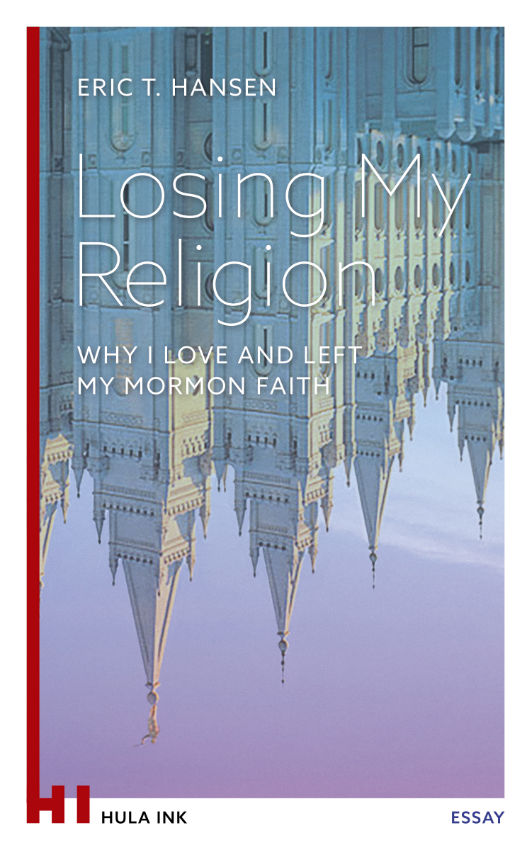
Growing up Mormon; relationship to god; getting to europe via mission; mission; losing my religion
So how did you like the Middle Ages?
Mixed. Hawaii really is paradise and the only true melting pot. Everything is beautiful, the people too. But some kids are not made for paradise. I was too skinny, my glasses too thick, too haole (white). I did not do well on the beach, on a surfboard or with the girls; not a week went by when the mokes did not beat or rob me. So I did what so many weaklings and social outcasts did before: I dreamed of escaping to Europe to become a writer. Only when I got here, did I realize what I gave up.
How to Find the Middle Ages
Academic history –BYU Hawaii/UH & LMU / Magister (got Niblreise
Germany was also where I met my first big love, and after my mission I returned to marry her and study the Literature of the German Middle Ages in Munich.
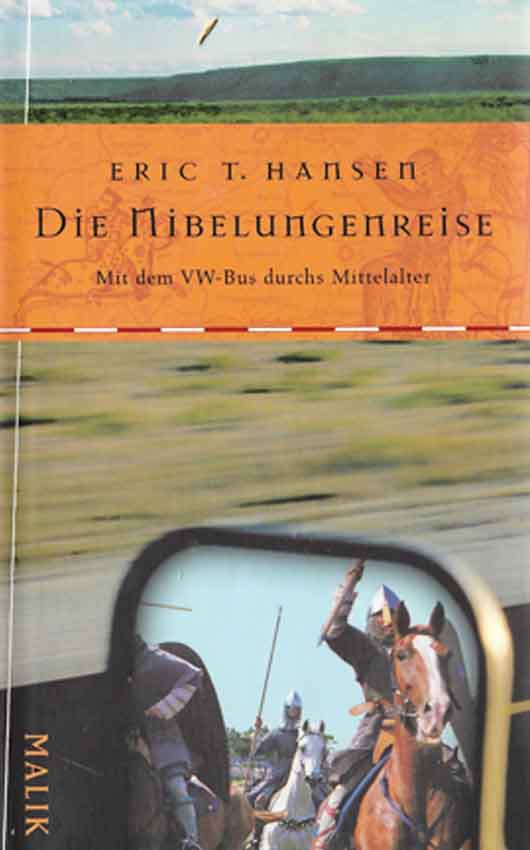
It was tougher than I had imagined to finish my studies in a foreign tongue – not because of the language but, but because I wasn’t a natural academic. I didn’t want to study the Middle Ages in a dusty library, I wanted to see them. Years later, that’s what I did: I dropped everything and took a year-long trip through Germany and Austria in a VW van from castle to monastery to village in the footsteps of nine medieval heroes, and that’s how I found the Middle Ages. That journey changed my life and became my first book, “Die Nibelungenreise.”
After the divorce, with only a few articles to my name, I moved to Berlin, which was still thrumming from the energy that exploded when the Berlin Wall came crashing down. I knew no one, and I am a shy guy – so I decided on a plan: I found the best bar within walking distance and vowed I would be there at least once a week and not leave until I had talked with someone or it was after one in the morning. I had not money, so I ordered one whisky and just held it, leaning against a wall and talking to no one, for hours. Before the year was out, I had friends and before another year had passed, I had fallen in love again. Here’s to the storied, the famous, the infamous Zoulou Bar.
When I turned 60, I stood at dawn with a cup of coffee on a nearby bridge in Berlin and looked back: Through the confusion and the succession of life events I never really had complete control over, I saw a strange process that is still not finished: In Hawaii I wanted to be somewhere and become something else; as a Mormon I thought religion would save me. When I left the church, I thought leaving it would save me. I thought becoming a writer would bring fulfillment, but now I am a writer an I am still searching. I can see what I did right and what I did wrong, and I can see the nonsense and confusion of human life, but I don’t know what any of that it means, and I don’t know if achieving fulfillment before the end is possible. But it seems to be that searching is not a bad way to spend your life in the meantime
So how was Europe?
Mixed. Hawaii really is paradise and the only true melting pot. Everything is beautiful, the people too. But some kids are not made for paradise. I was too skinny, my glasses too thick, too haole (white). I did not do well on the beach, on a surfboard or with the girls; not a week went by when the mokes did not beat or rob me. So I did what so many weaklings and social outcasts did before: I dreamed of escaping to Europe to become a writer. Only when I got here, did I realize what I gave up.
How to be an Ex-Pat in Europe
How living in Germany made an American out of me
And the definition of being young is when you believe it all. When I left America, I knew nothing about politics – I cared only about writing. But politics for Germans is what celebrity culture is for America: they talk about it constantly, and they know more about American politics than Americans. Or at least they think they do. I didn’t know then that Germany is, according to many polls, the most anti-American country in Europe. But the more you hear how terrible your country is, the more you start to question what you’re hearing. So I started to look into what I was hearing. Was America really dominating other countries with their exports of hamburgers, Coke and rock n roll? Not at all – in fact, the opposite is true: For every dollar of goods and services American exports take out of Germany, German exports in America send 2 dollars back home. Is Germany a socialist country, and American a capitalist one? Germany spends about 55% of their state budget on social services every year – America spends 65%. Is America racist? After all, every year, some 200 to 400 illegal immigrants on the Mexican border trying to get in. The number of annual deaths of illegal immigrants in the Mediterranean trying to get to Europe is between 2000 und 3000. What about America’s terrible history – slavery, the Indians? The Germans know a lot about that – they learn it in school. But what they don’t teach in school is this: It was the Portuguese who invented the transatlantic slave trade, nearly 100 years before America was discovered, and before slavery was banned throughout the Western world, the Portugiese, the Spanish and the French together imported more than 10 million to their South America colonies, while the English and The Americans collectively bought only about 600,000. And the Indians – when Columbus reached the Caribbean, there lived somewhere between 5 and 100 million aboriginal people in North and South America – when the first boatload of 200 English pilgrims set foot in New England, less than a million Indians had survived to live in North America. What about American imperialism? American wars? There’s a strange conundrum here – Germans are critical of American military force and self-congratulatory on their obvious pessimism – but when Putin invades a neighboring country to the EU, they turn to America for help. As of March 2023, Germany has contributed 4 million dollars in financial and military aid to the Ukraine – America has given 25 billion. Today, America is trapped in a vicious cycle of self-criticism and self-hatred – many young people really believe their country is the worst place in the world. Back when. was their age, I would have agreed – now I know that America, with all its faults, is still the greatest country in the world, and the one country all other countries in the West cannot do without.
So what’s so great about the German language?
A German friend once told me, “All German words sound like sausages,” and he right: They are earthy, sensual, brutal and full of imagery, humor and philosophy. “Doch” means “Yes” and “No” at the same time; “Glück” translates simultaneously to “happiness” and “luck” – that’s the language trying to tell you something; “Verschlimmbesserung” (yes, Germans can really read and say words like that) tells you everything you have to know about modern politics: “Making things worse by improving on them.”
How to …???
Image here???
???
So what’s it like writing in a foreign tongue?
Mixed. Hawaii really is paradise and the only true melting pot. Everything is beautiful, the people too. But some kids are not made for paradise. I was too skinny, my glasses too thick, too haole (white). I did not do well on the beach, on a surfboard or with the girls; not a week went by when the mokes did not beat or rob me. So I did what so many weaklings and social outcasts did before: I dreamed of escaping to Europe to become a writer. Only when I got here, did I realize what I gave up.
Press, Reviews & Awards
Video of TV stuff
Press
Reviews
Awards
So what do they think of America over there?
Write for a specific audience. I write for the woman I once saw on a nearly-empty bus far too early in the morning riding to work engrossed in a thick James Clavell novel.
How to Write About Politics in a Foreign Country
How to make everyone hate you in a foreign country / Adapt letter to Kent Ellwin /similar explanation
So how was Hawaii?
Mixed. Hawaii really is paradise and the only true melting pot. Everything is beautiful, the people too. But some kids are not made for paradise. I was too skinny, my glasses too thick, too haole (white). I did not do well on the beach, on a surfboard or with the girls; not a week went by when the mokes did not beat or rob me. So I did what so many weaklings and social outcasts did before: I dreamed of escaping to Europe to become a writer. Only when I got here, did I realize what I gave up.
How to Write with ADHD
Diagnosis, explains a lot, the torment, the beauty of loving all ideas, the unborn children, it’s all beautiful
So how was Hawaii?
Mixed. Hawaii really is paradise and the only true melting pot. Everything is beautiful, the people too. But some kids are not made for paradise. I was too skinny, my glasses too thick, too haole (white). I did not do well on the beach, on a surfboard or with the girls; not a week went by when the mokes did not beat or rob me. So I did what so many weaklings and social outcasts did before: I dreamed of escaping to Europe to become a writer. Only when I got here, did I realize what I gave up.
Now
Working on a new crime novel and a philosophical fable;
teaching, coaching
writing books abut writing
So how was Hawaii?
Mixed. Hawaii really is paradise and the only true melting pot. Everything is beautiful, the people too. But some kids are not made for paradise. I was too skinny, my glasses too thick, too haole (white). I did not do well on the beach, on a surfboard or with the girls; not a week went by when the mokes did not beat or rob me. So I did what so many weaklings and social outcasts did before: I dreamed of escaping to Europe to become a writer. Only when I got here, did I realize what I gave up.
The Long Version
My Life in Dates and Events
1960. Born Eric T. Hansen in Bellingham, Washington, number 5 of 6 kids.
1966. Family moves to Lanikai, Hawaii.
1978. Graduates from Kailua High School.
1979. Stays home for a year to write first novel.
1980. Goes on 2-year mission for the Mormon church to Germany.
1982. Studies linguistics at BYU Hawaii and University of Hawaii, earns money.
1983. Returns to Krefeld, Germany, marries the German girl he fell in love with.
1989. Receives Master’s (Magister) in Mediävistik (Literature of the German Middle Ages).
1990. Divorces, leaves Mormon faith, leaves academia, moves to Berlin to pursue journalism.
1990 – 2009. Freelances for The European, The International Herald Tribute, The Washington Post (German culture), Variety, Germany Bureau Chief or The Hollywood Reporter (media business); begins writing in German for Süddeutsche Zeitung, Cicero, GEO, Die Zeit, Hamburger Morgenpost (German-American politics), RBB (Radio); 2-year satirical political column “Wir Amis” for Die Zeit; Award: George Kennen Award for Journalism in Trans-Atlantic Relations for article in NZZ (Switzerland).
2001. Quit everything; 1-year journey through Germany and Austria in search of the Middle Ages.
2004. First book, “Die Nibelungreise”, in German, about medieval journey.
2005. Together with co-writer Astrid Ule, a dozen non-fiction books for major publishers about German-American culture, history and relations, including “Planet Germany” and “Planet America,” and successful thriller trilogy “Neuntöter,” “Blutbuche” and “Wassertöchter.”
Experiments in self-publishing: “Losing my Religion” and micro-publisher Hula Ink.
Covid: Began teaching creative writing, coaching young authors for writing schools and privately.
Now: Lives in Berlin with Astrid Ule, preparing series of English-language dark mysteries.